Guide: the technology explained
What is a 3D scan of a tattoo?
A 3D scan of a tattoo is a digital model of the tattooed body part that you can rotate and zoom on screen: the shape of the skin as a surface, with the tattoo as an image on it. At Inkmirra it is made from a short phone video whose individual frames are used to compute a 3D model. This principle is called photogrammetry.
Here you will learn how it works, what you need and where its limits are.
By Inkmirra · Updated: 1 November 2026 · 3 min read
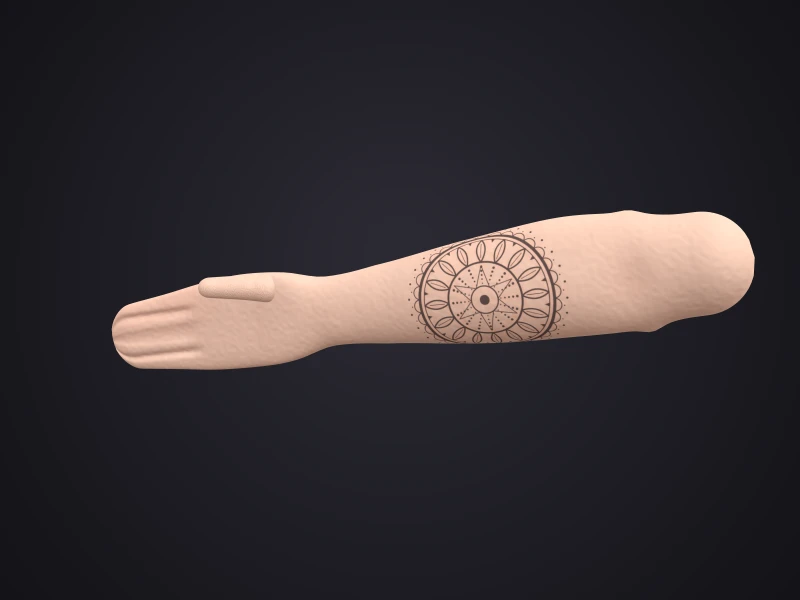
What a 3D model is made of
Surface
A net of many small triangles, called a mesh, recreates the shape of an arm, leg or back.
Texture
An image laid over that net. It shows the lines and colours of your tattoo.
Viewer
A program that shows both in the browser. You rotate, zoom and see the tattoo from every side.
How photogrammetry works
Many viewpoints
You film the area once all around. Each frame shows it from a slightly different angle.
Shared points
The software looks for distinctive points that appear in several frames, such as the lines of the tattoo.
Compute the shape
How these points shift between frames gives the camera positions and the shape in space.
Apply the texture
Finally, the image content is laid onto the computed surface. The result is a textured model.
Photogrammetry, LiDAR, AR filters: the difference
Photogrammetry
Works with normal camera images. Any current smartphone will do.
LiDAR and depth sensors
Measure distances with light. Some devices have such sensors; you do not need one for Inkmirra.
AR filters
Overlay a planned design on the camera image. That is a preview, not a scan of your real tattoo.
What makes a good scan
Photogrammetry needs images in which it can find the same points again. That leads to a few simple rules:
- Good, even light
- Film slowly and calmly around the area
- The person wearing the tattoo keeps as still as possible
- Avoid strong glare on the skin
- For large areas, a second person filming helps
Limits of a 3D scan
A scan from a phone video is a clear visual record, not a measuring instrument. It is good for capturing, showing and comparing a tattoo, not for medical evaluation.
Movement, weak light and shiny skin can lead to gaps or blurry areas. A second try in better light usually helps.
How a scan is made with Inkmirra
You add your tattoo, film for about 30 seconds and upload the video in the browser. Processing runs on our own, self-managed hardware in Berlin. You view the finished model in the 3D viewer, share it by link or compare it with new scans later.
You can download scans in full quality.
How-to: scan a tattoo in 3D →Questions about 3D scans
What is photogrammetry?
A method that computes the shape of an object in space from many images taken from different angles. The image content is then laid onto the model as a texture.
Do I need a phone with LiDAR?
No. For Inkmirra any current smartphone with a camera is enough, even without LiDAR or a depth sensor.
How long do I need to film?
About 30 seconds, calmly around the area and in good light.
Is a 3D scan more accurate than a photo?
It shows more: the whole tattoo all around, including where it wraps around the body. For single details, a good photo can be sharper. Neither is a measuring instrument.
Where are the videos processed?
At Inkmirra, on our own, self-managed hardware in Berlin.
Can I download the 3D model?
Yes, you can download scans in full quality. Up to 3 tattoos with 3D previews in viewer quality are free; prices are on the pricing page.