Guide for tattoo fans
Before a touch-up, cover-up or laser: recording the starting state
You record a tattoo's starting state by photographing or scanning it before the appointment with a fixed, repeatable setup: overview and close-up, uniform light without flash, the camera parallel to the skin, a size reference and the date. With the same setup you can later put every new state next to it.
This guide is only about documentation. Specialists advise you on the treatment itself, such as laser treatment; Inkmirra gives no advice on it.
By Inkmirra · Updated: 18 November 2026 · 3 min read
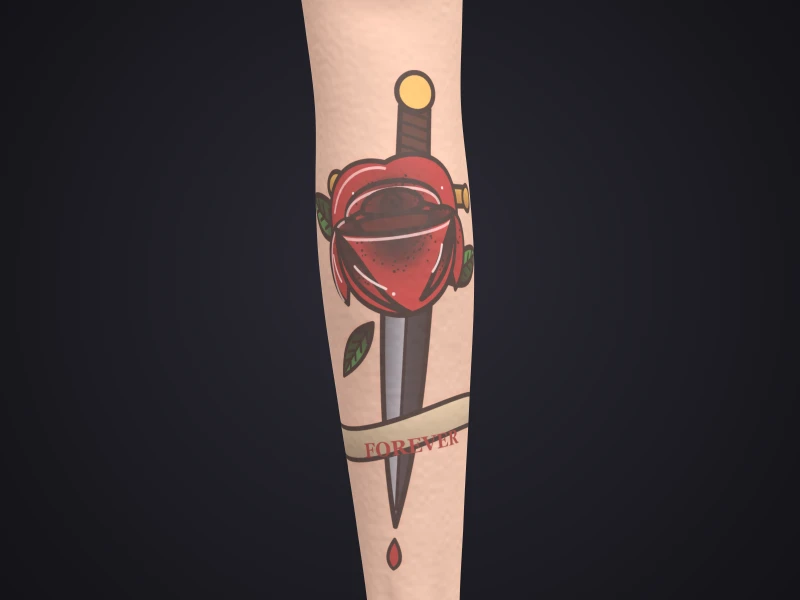
When a recorded starting state helps
Touch-up
Later you can see what was touched up.
Cover-up
The old design is kept as a memory and reference.
Before laser treatment
The state before the first session is on record. Specialists advise you on the treatment itself.
Any later comparison
With the same setup, later pictures can be put right next to it.
A setup you can repeat
Pictures only become comparable if they are taken the same way. Write down your setup so you can repeat it later:
- Place and light: uniform, diffuse light, generally no flash (NIST)
- Time of day: daylight changes with the time of day and cloud cover, so shoot at the same time if you can
- Distance: NIST recommends at least one metre to reduce perspective distortion; then zoom in
- Device and zoom level: the same as the first time
- Camera parallel to the tattoo, the tattoo centred
- A plain background without patterns, furniture or clothing
- The same body pose
Which pictures
Overview
Enough of the body to show where the tattoo is (NIST).
Close-up
The tattoo centred, filling at least three quarters of the frame (NIST).
Several views
If the tattoo wraps around an arm, leg or torso, several overlapping views (NIST).
Size reference
A tape measure or ruler next to the tattoo, in the same plane as the skin. A forensic imaging guideline by SWGDE for impressions sets the same rule: scale in the same plane, camera parallel.
What to note down
- Date of the pictures
- When and where the tattoo was done, artist or studio
- The occasion: touch-up, cover-up or laser
- Your setup: place, time, device, zoom level, distance
Step by step
Fix the setup
Choose and note place, light, distance, device and pose.
Overview and close-up
Camera parallel to the tattoo, tape measure in the same plane as the skin.
More views
Several overlapping views on curved areas.
3D scan
About 30 seconds of video all around, uploaded in the browser.
Save
Keep everything with the date in one fixed place.
Also as a 3D scan
A 3D scan captures the whole area all around, including where the tattoo wraps around the body. At Inkmirra you link several scans to one tattoo; they are aligned automatically, then you blend or wipe with a slider.
Your pictures are private by default. You can share them by a link you can time-limit and end, and you get your own copy as a data export (ZIP) in your profile.
Important
Documentation only
Inkmirra documents and compares; it does not assess anything and gives no advice on touch-ups, cover-ups or laser treatment. Your artist and, for laser treatment, specialists advise you on that.
Sources
General statements in this guide are based on these sources. Statements about Inkmirra describe the app's features.
- NIST: Tattoo Recognition Technology – Best Practices (Tatt-BP), Guidelines for Tattoo Image Collection, Revision 1.0 (2016)
- SWGDE: Guidelines for the Digital Imaging of Footwear and Tire Impressions, Version 1.0 (2018)
- Cambridge in Colour: Making the Most of Natural Light in Photography
- Google: Pixel Camera Help – Get started with photos on your Pixel phone or tablet
Questions about the starting state
When do I record the starting state?
Before the appointment at which the tattoo is to be changed, so the last state before it is on record.
Is one photo enough?
The NIST tattoo photography guideline recommends at least two: an overview and a close-up, and several views on curved areas.
What is the tape measure in the picture for?
It gives a size reference that still holds when distance or framing differ slightly later. It should lie in the same plane as the skin.
Does Inkmirra help me with the decision or the treatment?
No. Inkmirra only documents. Get advice from your artist and, for laser treatment, from specialists.
How do I compare before and after?
Photograph with the same setup and put the pictures side by side, or at Inkmirra link both scans to the tattoo and blend them.